Over 30 Years of Energy Efficiency Excellence
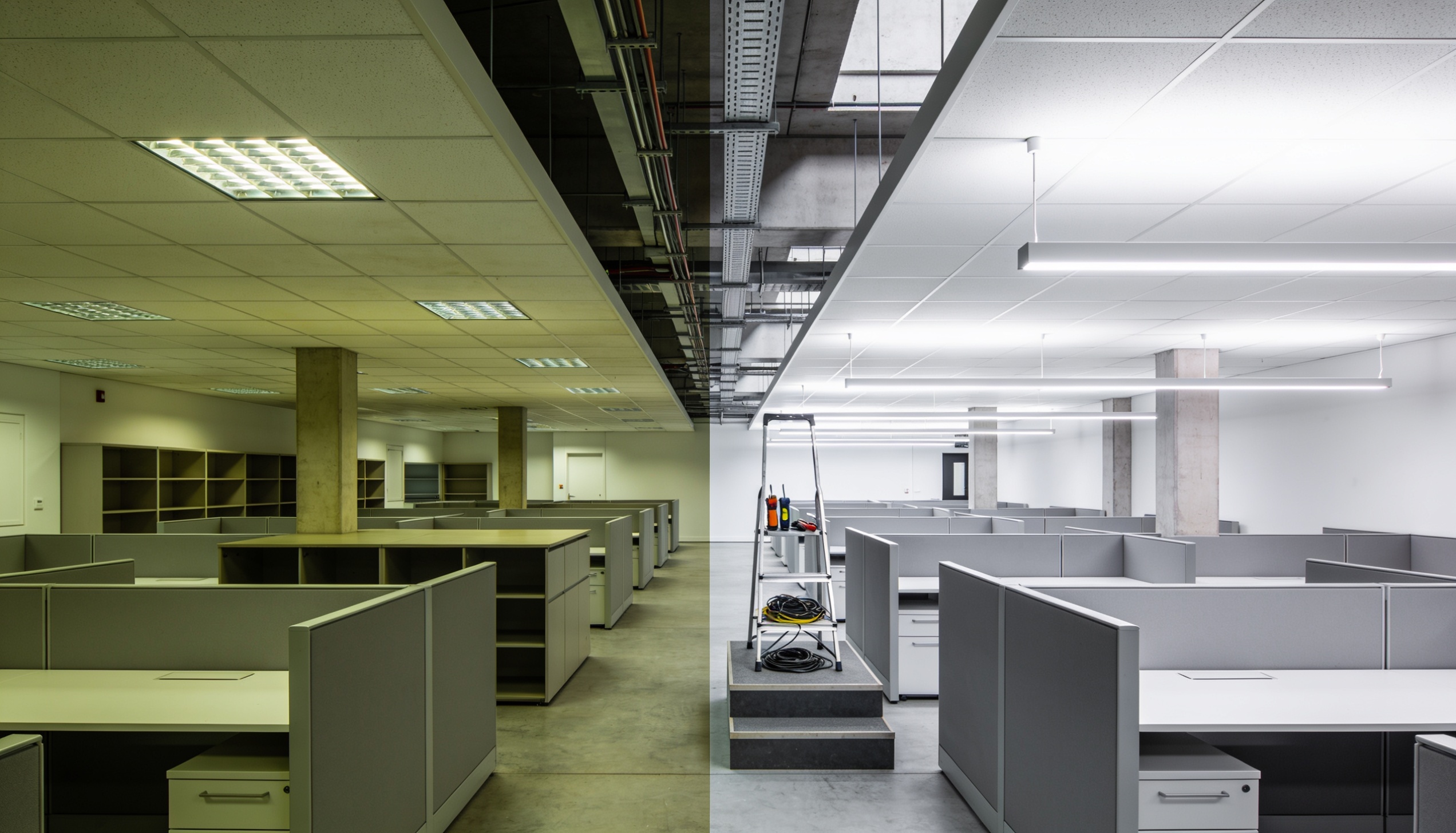
For most facilities managers, lighting only reaches the top of the agenda when something forces it there. Right now, two things are doing exactly that: the lamps that lit Britain's offices, wards and warehouses for decades are being withdrawn from sale, and energy costs have made inefficient installations impossible to ignore. The good news is that LED technology has matured to the point where upgrading is less a leap of faith than a straightforward engineering decision. This guide covers why outdated lighting has become a liability, what the phase-out regulations actually say, how the technologies compare, and how to plan a retrofit that pays its way.
Lighting typically consumes around 20% of the electricity used in commercial and industrial buildings, according to the Carbon Trust. In a building still running halogen or older fluorescent sources, a large share of that consumption is simply wasted as heat — and the costs do not stop at the meter.
Tell-tale signs that an installation is overdue for review include:
Each of these is an operational cost. Together they are usually a stronger business case than energy savings alone.
The UK government ended the sale of most general-purpose halogen bulbs from 1 September 2021, citing savings of 1.26 million tonnes of carbon a year from the wider lighting package — the equivalent of removing over half a million cars from the UK's roads. The same announcement confirmed that fluorescent lamps would follow, with sales ending from September 2023.
The decisive step for non-domestic buildings came through the GB RoHS regime. The Restriction of the Use of Certain Hazardous Substances in Electrical and Electronic Equipment (Amendment) Regulations 2023 ended the exemptions that allowed mercury in compact fluorescent lamps and in double-capped linear fluorescent lamps — including the T5 and T8 tubes found in countless offices, schools and plant rooms — from 1 February 2024.
To be clear: it is not illegal to keep using fluorescent fittings. But new tubes can no longer be placed on the GB market, so distributors are selling through remaining stock. For a facilities manager, that means every fluorescent luminaire in the portfolio is now running on a finite — and increasingly expensive — supply of spares. Planning an orderly upgrade beats an emergency one.
On raw efficiency, the gap is wide and still widening. The International Energy Agency notes that LEDs typically available in the residential market achieve over 100 lumens per watt, with best-in-class technologies exceeding 200 lm/W — roughly twice the efficiency of fluorescent — and that average LED efficacy has improved by around 4 lm/W every year since 2010.
| Criterion | Halogen | Fluorescent (T8/T5, CFL) | LED |
|---|---|---|---|
| Luminous efficacy | Low — most input energy is lost as heat | Moderate | High — typically over 100 lm/W and roughly twice fluorescent efficiency |
| Lamp life | Shortest of the three — LEDs last around five times longer than halogen | Moderate — tubes degrade and need scheduled replacement | Longest — chip makers quote up to 50,000 hours |
| Maintenance burden | Frequent lamp changes | Periodic tube, starter and ballast replacement | Minimal scheduled relamping; drivers are the main serviceable item |
| Controls and dimming | Dimmable but inefficient at every output level | Limited; requires dimmable ballasts | Native support for PIR, daylight harvesting and dimming |
| UK market status | Most sales ended September 2021 | GB RoHS exemptions expired 1 February 2024 | The standard for new supply |
The Carbon Trust estimates that replacing halogen lighting with LED can cut electricity consumption on those circuits by between 65 and 85 per cent, while replacing CFL or HID sources delivers savings in the region of 20 per cent. The government's own figures point the same way: LED bulbs produce the same amount of light as halogen while using up to 80% less power.
Those figures come with an important caveat — savings depend on design quality, not just technology:
"When LED units are used as part of a poor lighting design the lighting solution may actually consume more energy than the alternative conventional lighting technologies." — The Carbon Trust, on why LED retrofits should be designed rather than simply swapped
That is why a photometric study matters. It confirms that the proposed layout will deliver the required lux levels and uniformity for each task area before any money is spent — and it frequently shows that fewer, better-placed luminaires can outperform a one-for-one swap.
Controls multiply the savings. Pairing LED with PIR sensors, daylight harvesting and dimming systems ensures light is only delivered when and where it is needed — particularly effective in intermittently occupied spaces such as corridors, stairwells and warehouses.
LED chip manufacturers commonly quote lifetimes of 50,000 hours, though the Carbon Trust cautions that complete luminaire lifetimes can be shorter — closer to 30,000 hours in some cases. Even on the conservative figure, that is far beyond typical fluorescent relamping cycles, and the practical implications go well beyond the cost of lamps:
Not every upgrade means ripping out ceilings. There are three broad routes, and most estates end up using a mix:
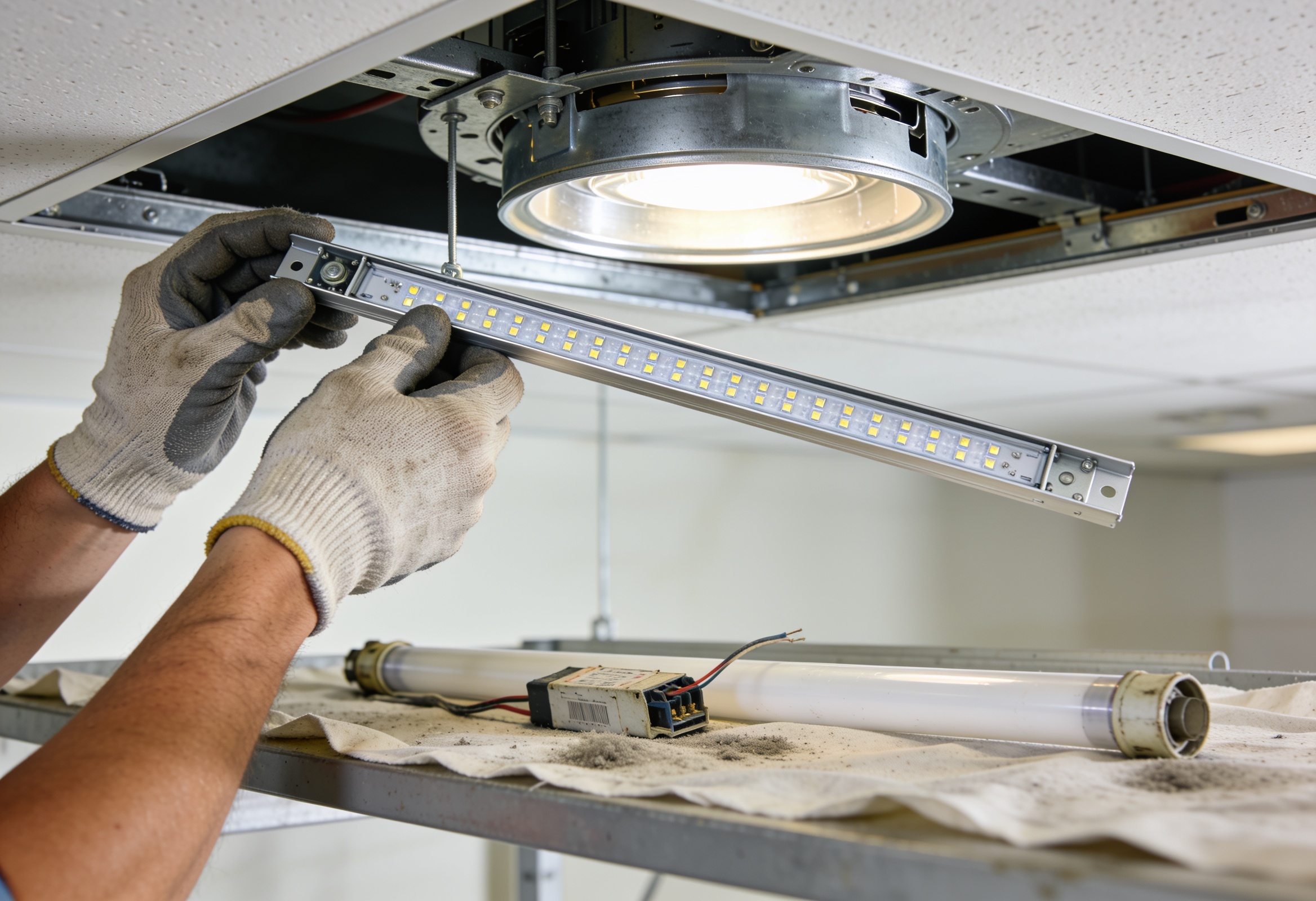
The right mix depends on the condition of the existing fittings, ceiling types, access constraints and the photometric requirements of each space — which is exactly what a site survey establishes.
A well-run LED upgrade follows a predictable sequence:

Treating the survey and photometric stages as optional is the most common — and most expensive — mistake. They are what turn an LED swap into an engineered upgrade.
Morgan Hope Industries is a Southport-based specialist supplier of energy-efficient LED lighting, lighting controls and heating systems, established in 1992. We supply and help specify retrofit solutions — including site surveys, photometric studies and bespoke retrofit gear trays — for organisations across the UK, with ranges selected for commercial, industrial, healthcare and care home and social housing environments.
If your estate is still running fluorescent or halogen lighting, the sensible first step is a conversation, not a catalogue. Get in touch to arrange a site survey, or browse the range to see what a modern specification looks like.