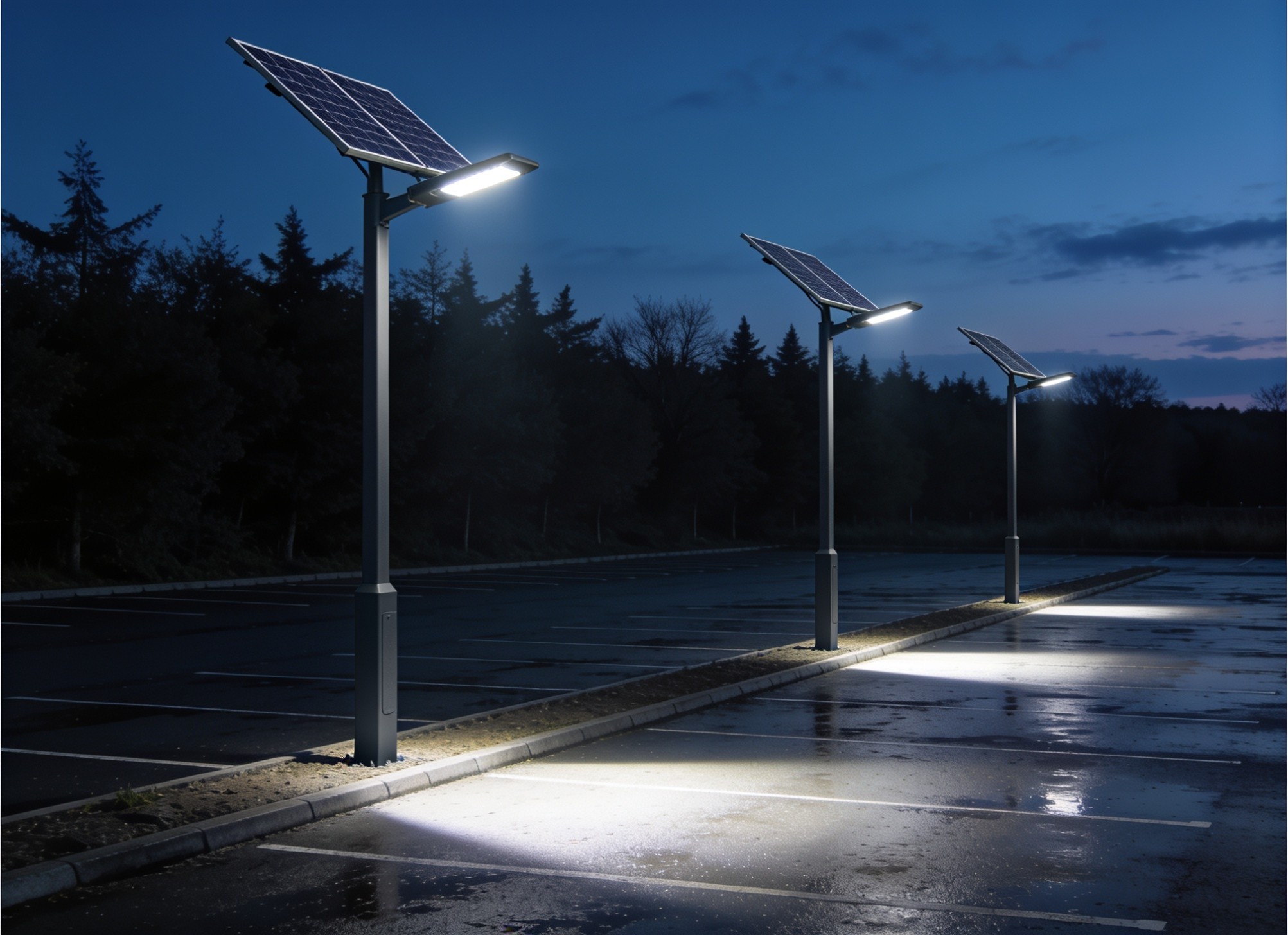
Over 30 Years of Energy Efficiency Excellence
Street lighting is one of those services nobody notices until it fails — and one of the budget lines finance teams notice every single year. According to the UK Roads Liaison Group's State of the Nation 2020 streetlighting survey, the UK operates just under 7.2 million streetlights, consuming around 1,887 GWh of electricity annually at a cost of roughly £302 million — and producing some 478,000 tonnes of CO₂ each year.
LED conversion can reshape those numbers: the UK Green Investment Bank reported that councils making the switch to LED could see street lighting electricity bills up to 80 per cent lower. But every mains-fed light still carries two permanent obligations — an energy bill and a cable in the ground. Stand-alone solar street lighting removes both. For councils, estates, car-park and site operators, that changes the economics of exterior lighting in very practical ways.
A modern solar street light is a fully self-contained system mounted on a single column or bracket:
Because everything lives on the column, there is no connection to the electricity network at all. That one design decision drives almost every benefit that follows.
It is easy to underestimate what a new mains connection actually involves. Under Ofgem's guidance on getting a new electricity connection, a new supply means applying to your regional distribution network operator (DNO), paying for the work in advance — a price that covers the assets built solely for your use plus a proportion of any network reinforcement — and, once the DNO has the information it needs, allowing up to three months simply to receive connection terms.
Then the civil works begin: trenching, ducting, cabling and reinstatement of every surface the route crosses. On a finished car park that means cutting through tarmac; on a landscaped estate it means disturbing planting, drainage and buried services. None of it delivers a single lumen — it is pure enabling cost.
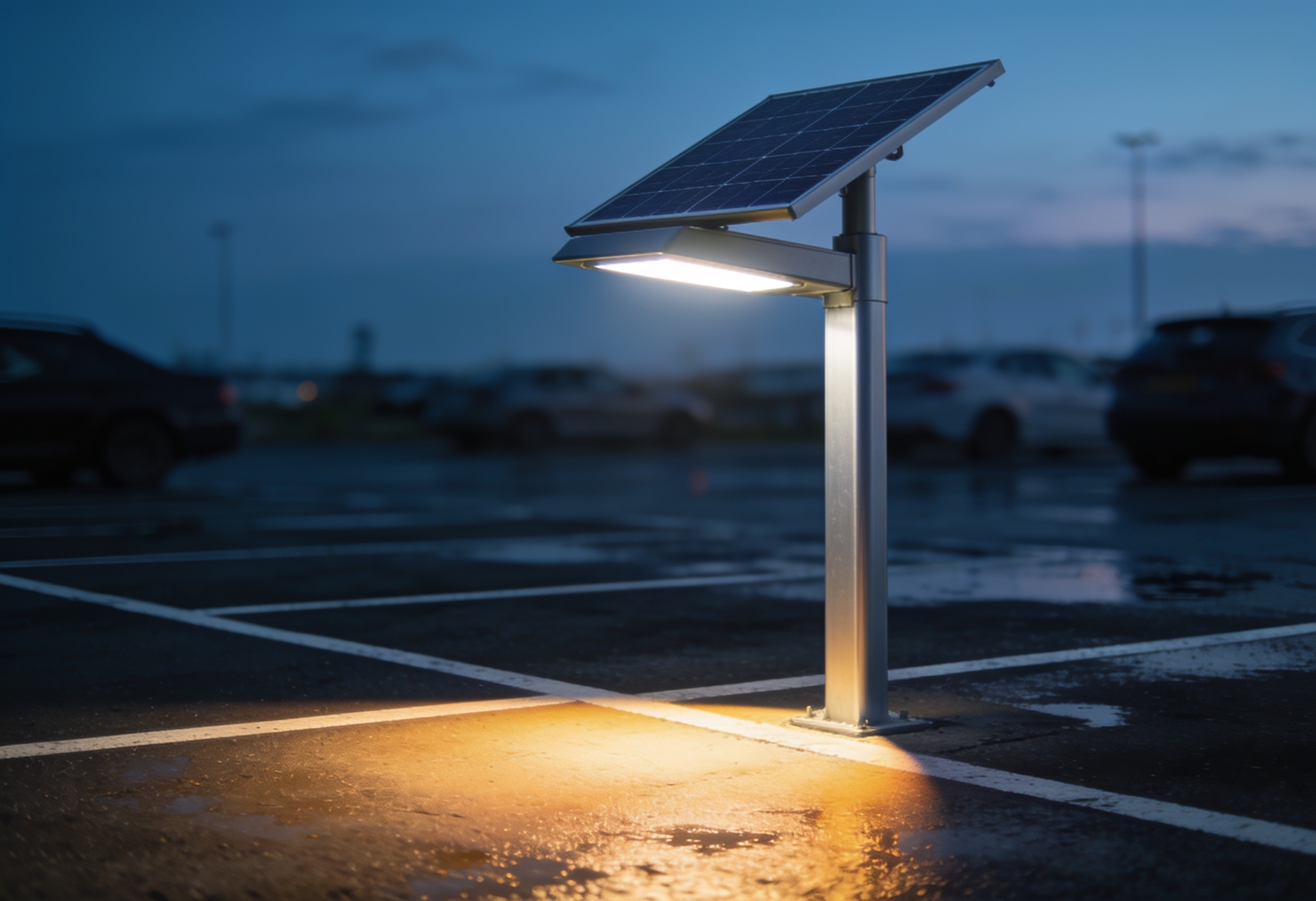
A solar unit needs a foundation — and nothing else. There is no application to the DNO, no advance connection payment, no cable route to negotiate across private land, and no excavation through finished surfaces. For sites where the lighting points are a long way from the nearest supply, removing the cable run is usually the difference between a viable scheme and an abandoned one.
Once installed, the lighting is free at the point of use. There are no metered or unmetered supply charges, no exposure to electricity price volatility, and no energy administration for the life of the asset. For operators running dozens of lighting points across multiple sites, the budgeting certainty is as valuable as the saving itself.
Mains lighting can be dimmed too — but it is usually an upgrade decision. With solar it is intrinsic: managing a finite nightly energy budget means movement detection and dimming come built in. A typical profile rests the luminaire at a low standby output and lifts it to full power when presence is detected. The industry has been pointing this way for years:
"The design requirements in BS 5489 allow road lighting levels to be lowered during periods of low traffic volumes… This presents an opportunity for local authorities to optimize their lighting levels." — UK Roads Liaison Group, State of the Nation 2020 Streetlighting Survey
Solar lighting simply makes that optimisation the default rather than the exception.
With no third-party connection process on the critical path, projects move at the pace of groundworks alone. The Astrid solar systems we supply are deployable in days rather than weeks, and a failing mains-fed column can be replaced one-for-one without re-wiring the site. If the layout changes later — a car-park reconfiguration, a new walking route — a self-contained unit can be relocated without abandoning buried cable.
Each solar light is its own island: a cable fault or supply interruption elsewhere on site cannot take it down. And because it draws nothing from the grid, its operational electricity consumption — and the carbon that goes with it — is zero, which makes solar lighting an easy line to defend in any net-zero or estate decarbonisation plan.
| Consideration | Mains-fed street lighting | Stand-alone solar lighting |
|---|---|---|
| Grid connection | DNO application and advance payment; allow up to three months for connection terms | None required |
| Civil works | Trenching, ducting, cabling and surface reinstatement along the route | Column foundation only |
| Running energy cost | Ongoing metered or unmetered supply charges | Zero at the point of use |
| Lighting controls | Dimming and CMS available, often as an upgrade | Movement sensing and dimming typically standard |
| Maintenance | Luminaire, control gear and an ageing underground cable network | Luminaire, panel cleaning and periodic battery replacement |
| Relocation | Costly — a new cable route is required | Straightforward — the unit is self-contained |
A fair comparison should note solar's own considerations: the column position needs reasonable solar access (watch for tree cover and building shadow), batteries are a consumable with a finite service life, and schemes must be sized honestly for December, not June.
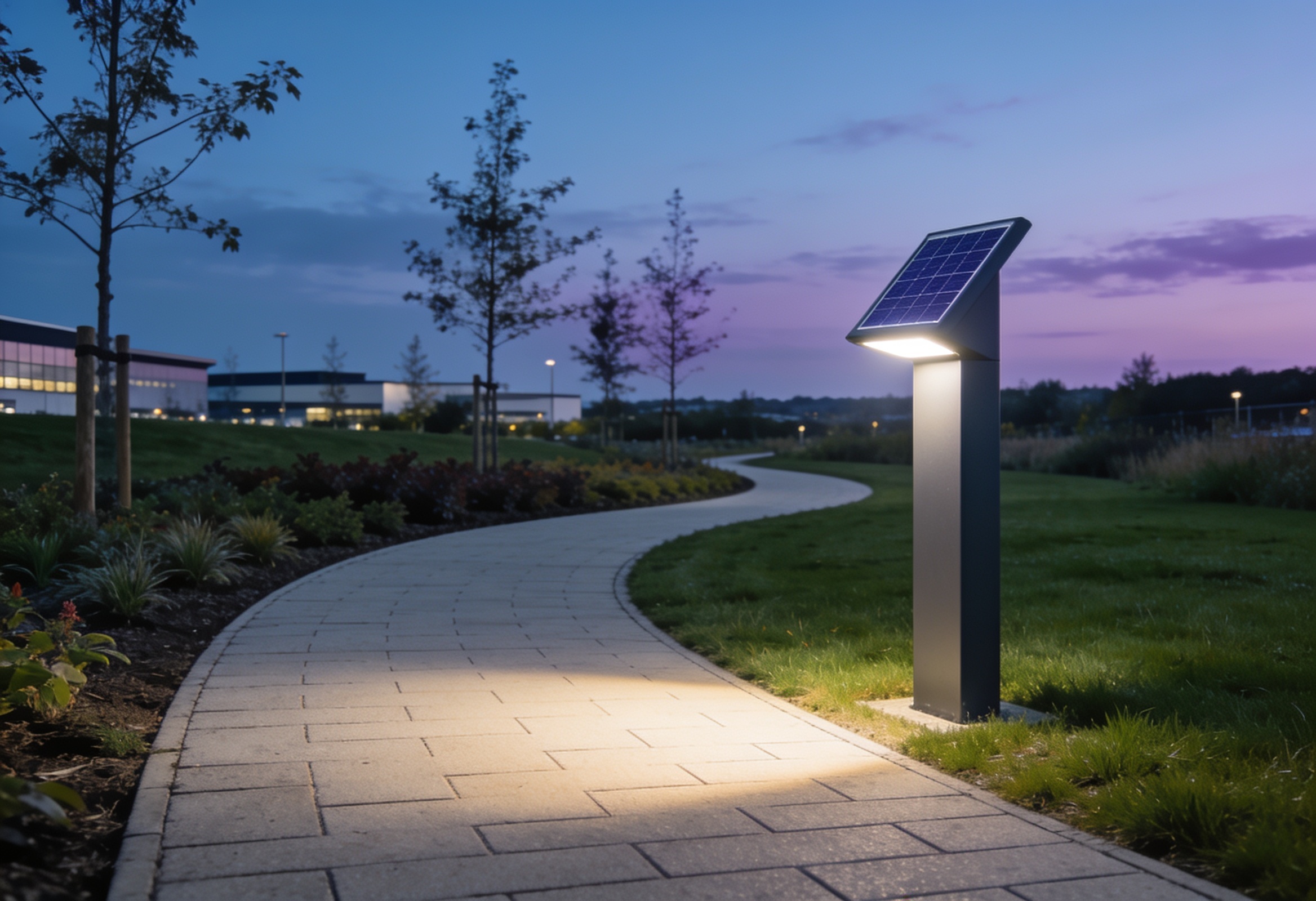
Solar lighting succeeds or fails at the specification stage. Short days and long nights in midwinter mean the system must harvest less and deliver more, so we specify battery storage sized for UK conditions, with multi-night autonomy through British winters. The key checks for any scheme are panel orientation and shading at the actual column position, battery autonomy across consecutive dull days, an appropriate ingress-protection rating for permanent exterior use, and standby and boost light levels that suit the risk profile of the space.
Morgan Hope is a Southport-based specialist supplier of energy-efficient LED lighting, established in 1992. We supply a comprehensive range of industrial and commercial solar lighting for the UK market — the Astrid solar range — covering solar street lights, lighting columns and area floodlighting for car parks, pathways, depots, compounds and remote sites, including the Astrid HighLite SPT, Olympic Combi and Pro, Curzon, Prostar SSL and the HighLite SPSL and SCL series. Every Astrid unit is fully self-contained — its own PV panel, battery storage and LED head — so there is no grid connection, no trenching and no civil works. You can browse the solar products in the store.
For smaller amenity applications, the Astrid SSL ProStar 1-MS shows how capable compact solar lighting has become:
If you are weighing up a lighting scheme for a car park, pathway, depot or estate, the quickest way to test the case for solar is a site survey. Tell us about your site and we will come back with a solar lighting layout, cost and payback estimate — request a site survey, or start with our solar lighting overview.